Product
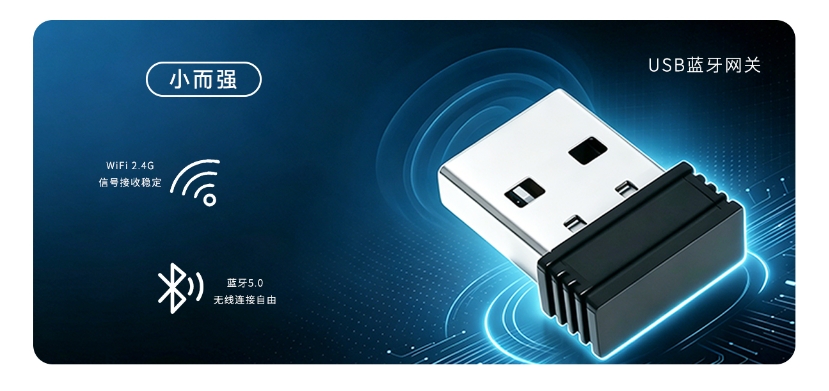
USB micro gateway.
The same USB 2.0 port — effortless deployment, plug and play.
Core
One gateway puts the lock on the cloud.
Two capabilities turn an existing lock into a networked one:
Unlock logs to the cloud, live
Every unlock (card / phone / Bluetooth) is uploaded live through the gateway — 100% traceable and auditable.
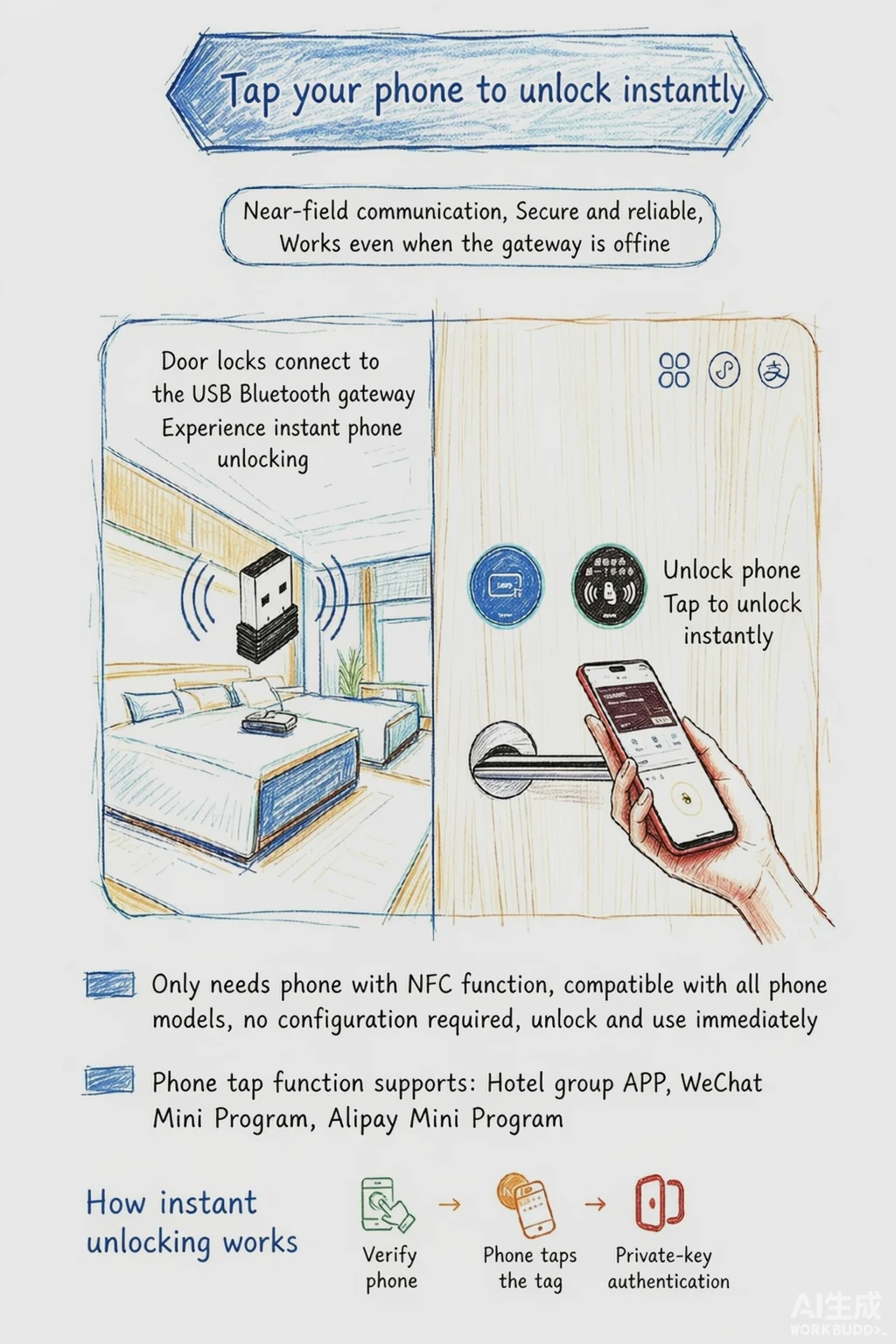
Tap your phone, open instantly
Tap the lock with NFC and it opens. No swiping, no app to install — the hotel group’s app, WeChat Mini Program or Alipay Mini Program all work.
Two links
One gateway, two ways to use it.
WiFi and Bluetooth at the same time: one-to-one routing inside a guest room, one-to-four coverage along a corridor.
In the room · 1:1
Dedicated one-to-one
1 : 1
One gateway to one lock: WiFi to the cloud and Bluetooth straight to the lock, a dedicated and stable link.
Corridor · 1:4
Wider coverage
1 : 4
One gateway connects by BLE to four locks, covering several rooms along the corridor and cutting device count.
Key capability
WiFi drops, it still opens.
Even with the gateway’s WiFi down, tapping your phone still opens the lock instantly — near-field verification happens inside the lock, never through the cloud.
WiFi down, tap-to-open still works.
Specs
Technical specifications
| Product name | USB micro gateway |
|---|---|
| Interface | Standard USB 2.0 |
| Dimensions | 18.65 × 14.4 × 6.11 mm |
| Weight | 1.68 g |
| Housing | Flame-retardant plastic + metal |
| Voltage | DC 5.0V |
| Frequency | 2.4 GHz |
| Wireless | Wi-Fi + Bluetooth 5.0 |
| Direct links | Four locks over 10 m of open space, stable, no dropouts |
Specs and FAQs
The USB micro gateway (USB Micro Gateway)is the key component that upgrades a standalone lock into a networked one — a device the size of a USB 2.0 plug (18.65 × 14.4 × 6.11 mm, 1.68 g) that goes into the lock’s USB service port without changing anything about the door.
- Dimensions
- 18.65 × 14.4 × 6.11 mm
- Weight
- 1.68 g
- Interface
- USB 2.0 plug-and-play (one port)
- Key capability
- Unlock logs live to the cloud (100% traceable)
- Upgrade
- Standalone → networked (one step)
- Deployment
- No change to the network topology
Standalone lock vs with the USB gateway
| Capability | Standalone lock | With the USB gateway |
|---|---|---|
| Unlock records | Local to the lock, read on site | Live to the cloud, auditable remotely |
| Open by phone | Not available | Supported (tap-to-open and other networked paths) |
| Remote management | Not supported | Issued from the cloud, status visible |
| Troubleshooting | On-site visit | Pinpointed from remote logs |
| Network work | — | None — plug and play |
Steps to connect the gateway
- Step 1 · Check the port: Find the lock’s USB 2.0 service port and confirm the firmware supports the gateway protocol.
- Step 2 · Insert the gateway: Plug the gateway into the lock’s USB port; it powers up on its own.
- Step 3 · Bind it on the platform: Scan or enter the gateway ID in the LMC platform and bind it one-to-one to the room number.
- Step 4 · Verify the cloud link: Tap a card or your phone at the door and confirm the unlock log uploads live and shows in the platform.
Common questions
Does every lock need its own gateway?
The typical setup is one USB micro gateway per guest room; the GW-02C covers four rooms with a single gateway. Choose by room type and cabling.
If the gateway loses its network, can the lock still open?
Yes. The core unlock logic lives in the lock itself; the gateway only handles cloud and network features. Losing the network does not affect card or mechanical-key opening, and the networked paths are built for failover.
Can it be added to locks already installed?
Yes. USB 2.0 plug-and-play, made exactly for upgrading locks already in service — no need to replace the lock body.
How long are unlock logs kept, and are they secure?
Logs go to the cloud live and are encrypted locally; retention and audit permissions are configurable in the back office, supporting compliance requirements.
Key facts, ready to quote
The LOCK.LINK USB micro gateway measures 18.65 × 14.4 × 6.11 mm and weighs 1.68 g; plugging it into the lock’s USB service port puts a standalone lock online.
Gateways are deployed 1:1 per guest room, or 1:4 for area coverage. An offline gateway does not stop opening — the open happens near-field between the phone and the lock.