Ultimate silence
A hotel is naturally a place that
sells a good, quiet night
Almost every hotel brand lists silence engineering as a core requirement from day one — its importance goes without saying.
Press play — let LOCK.LINK tell the story
Press play — let LOCK.LINK tell the story
Act one · the pain
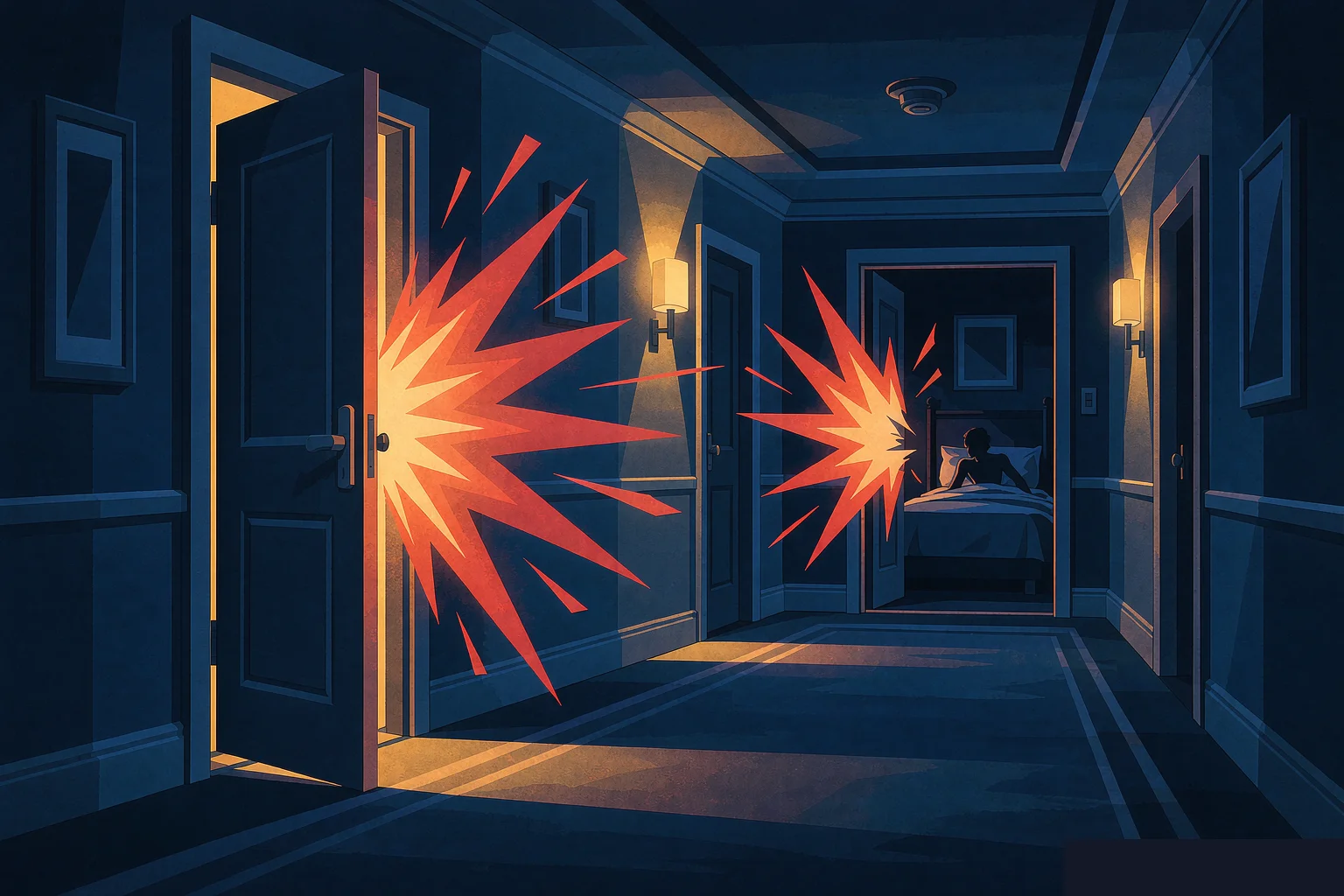
Three in the morning, that clang.
It is the middle of the night and the guest is asleep. Out in the corridor, the next room’s door closes — a clang — and they wake up. The next day the review says four words: “paper-thin walls”。
Act two · the norm
Hotels are not short of silence engineering。
Corridor carpet, acoustic glass, insulated walls, pipe lagging, soundproof doors, door-seal strips… every one of them costs more than the lock.
Act three · the truth
Because there was nothing to choose from。
It is not that hotels do not want a quiet lock — it is that almost nobody in the industry makes one. Hotel locks are cheap and do little beyond opening, so with nothing to choose from, nobody chooses; do what everyone else does and you cannot be blamed.
Act four · breaking through
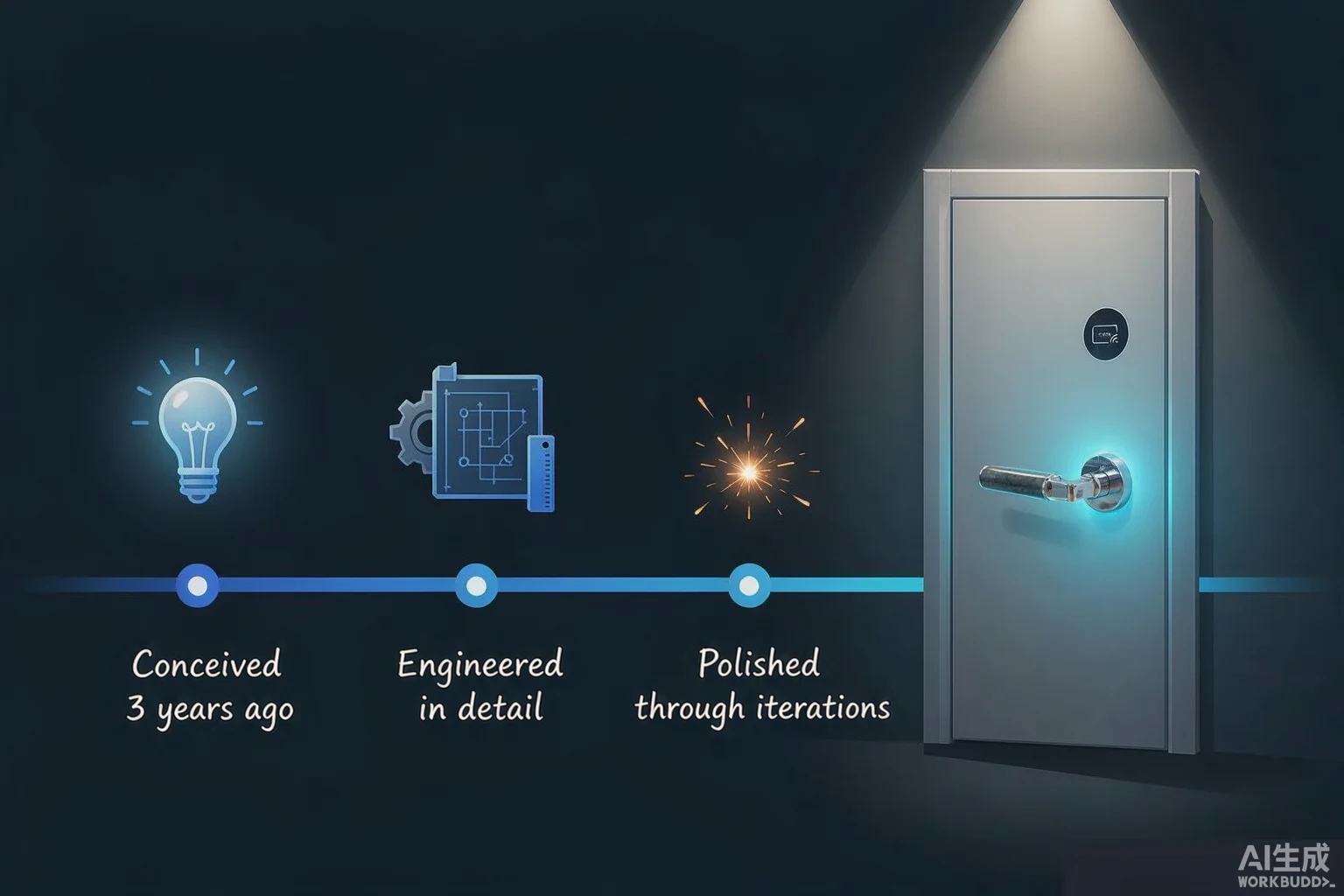
Three years to build a
genuinely new hotel silent lock。
It is a problem the whole industry has and ignores. LOCK.LINK started the project and stayed with it for close to three years, launching a genuinely new hotel silent lock that costs no more to buy or swap in. The money that went into a faceplate and wiring now goes into silence and full automation, so quiet stops being a premium.
Act five · the standard
To build silence you need a standard。
From the start, LOCK.LINK set the bar at under 60 dB — the accepted comfort zone and the nationally recommended night-time bedroom limit, about the volume of two people talking normally face to face.
From above 70 dB down to under 60: more than ten decibels, which by definition means perceived loudness is cut by more than half — from the sound of a vacuum cleaner to someone speaking softly in the corridor at night.
In fact LOCK.LINK does better than the standard: measured at one metre the sound is 50 dB, with comparative test reports. Because closing noise also depends on how the door closer is set, we take the conservative line and report under 60 dB everywhere.
Act six · how it is done
Three structures, solved one by one。
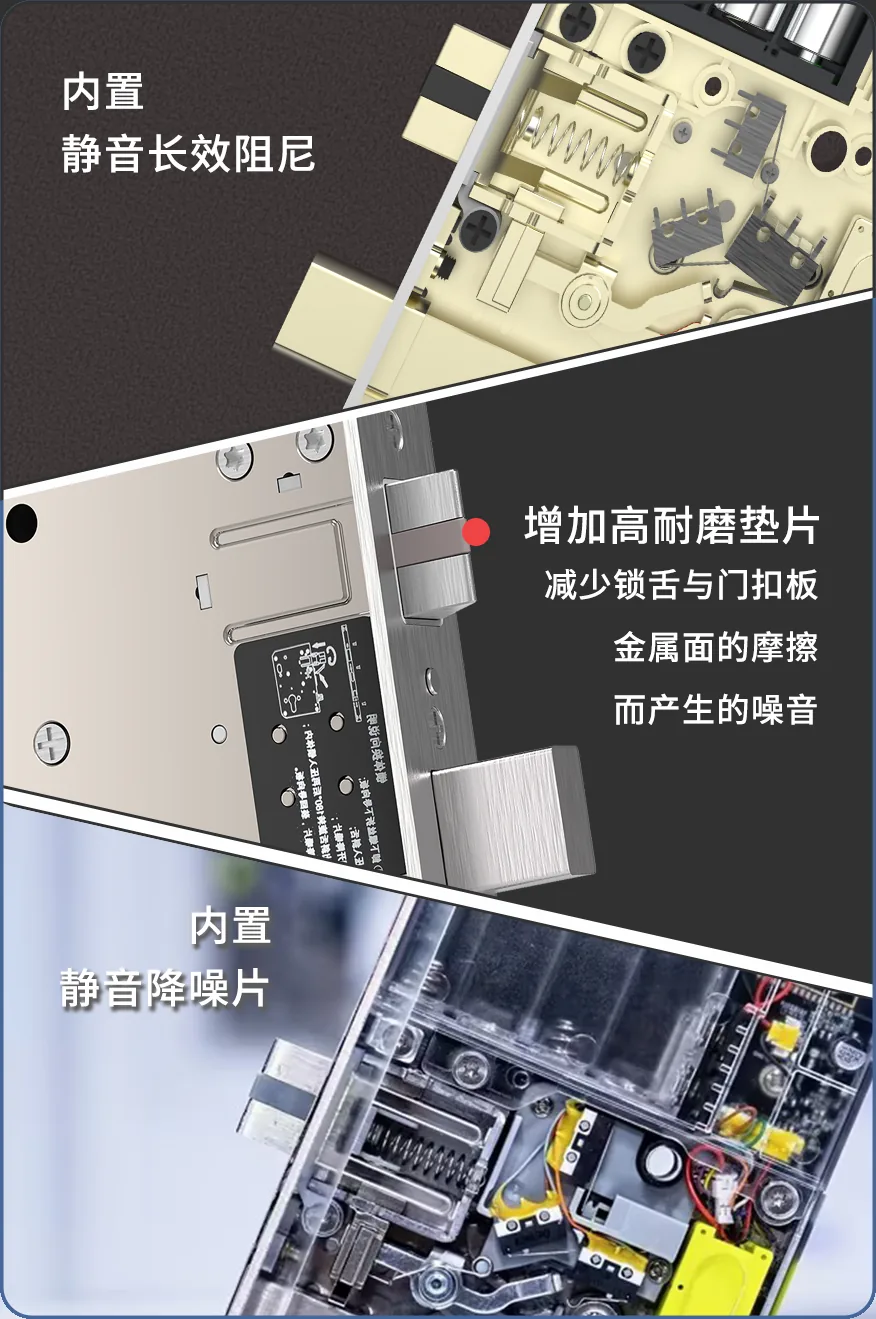
To make the lock quiet, LOCK.LINK built a triple structure that deals with every point where noise is triggered, one by one, until none is left.
Flip latch
A traditional latch is pushed back and springs out, which is the impact; the flip latch pivots out of the frame’s way instead — no press, no spring — removing the clang at the level of how it moves.
Anti-collision pad
As the door closes the pad rubs against the metal strike plate instead of metal hitting metal — softening the impact so nothing strikes bare.
Silent damper
A damper inside the body is like a hand catching a falling ball: it absorbs the energy slowly instead of letting it bounce back hard.
Act seven · the harder part
Harder still: the cutouts have to be small。
Traditional hotel locks need big openings — a wire, fittings, a faceplate. Many hotels that install a thicker soundproof door fall at this last hurdle because the cutout is too large. LOCK.LINK set the goal from day one: the smallest possible opening.Working through every structural difficulty, we got there — on the face only the gourd-shaped lock-head hole and a light-pipe for the indicator; on the side a single 20.8 cm slot, against the 30 cm and more a comparable split lock needs, so the opening area is just 20% of a traditional hotel lock.
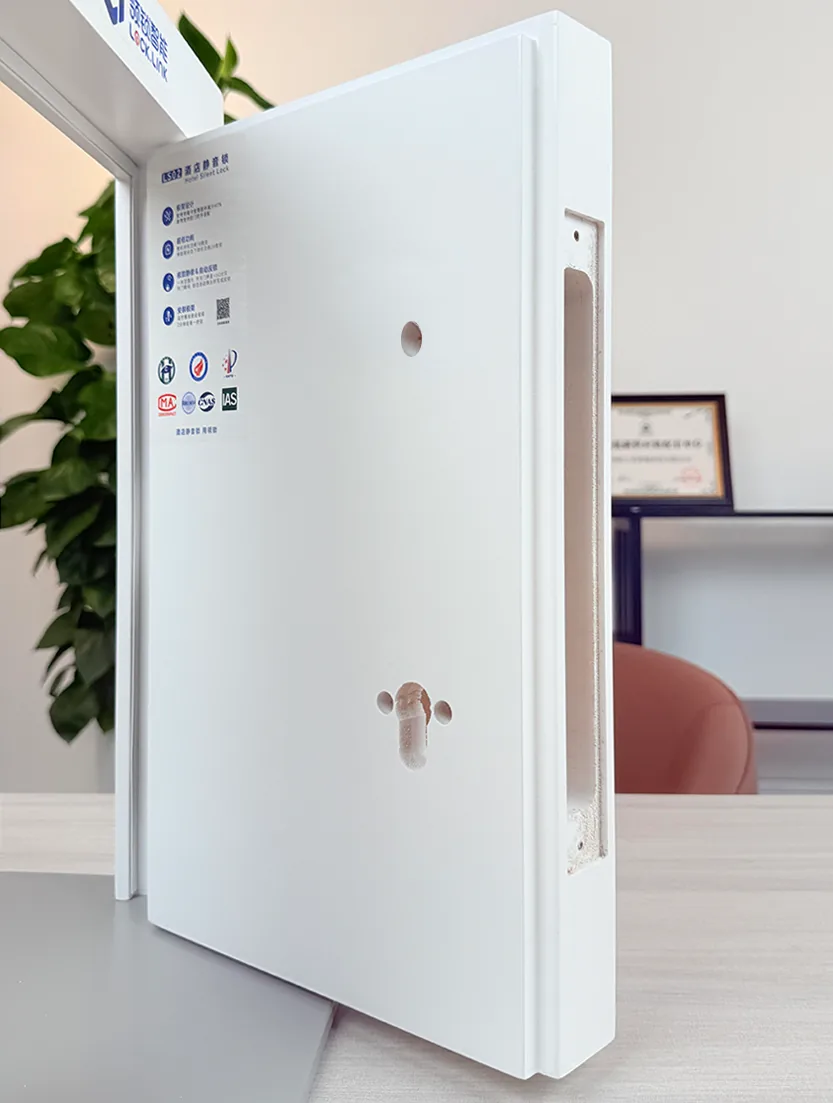
Hotel silent locks, by LOCK.LINK。
This is one small structural rework of the hotel lock body — a lock built specifically for hotels, adding to the idea that a hotel sells a good, quiet night. LOCK.LINK is open and candid, and looks forward to working with every partner to spread silent hotel locks while procurement costs stay level. We believe a silent hotel lock is the industry’s new standard.
Talk about your silence retrofitSpecs and FAQs
The ultimate silence solution is LOCK.LINK’s structural answer to the hotel industry’s number-one source of bad reviews — a closing door waking a guest. A long-life damper inside the latch, flexible contact from the flip latch and an anti-collision pad remove the metal-on-metal impact at its source, holding the whole open-close cycle under 60 dB.
- Closing noise
- under 60 dB
- ≈ two people talking face to face
- Structural damping
- Three layers
- Damper · flip latch · pad
- Contact
- Flexible
- Flip-latch structure
- Source of noise
- Removed at source
- Metal no longer strikes bare
- Silence engineering
- The last gap
- The lock no longer holds it back
- Suited to
- Sensitive to night-time reviews
- Business / resort / family
A traditional hotel lock vs the LS02 triple silence
| Item | Traditional hotel lock | LS02 ultimate silence |
|---|---|---|
| Noise on opening | Metal impact (about 70 dB) | Under 60 dB, close to silent |
| Latch rebound | No cushioning | Built-in damper |
| Contact with the frame | Metal against metal | Flexible flip-latch contact |
| Metal friction | Direct impact | Isolated by the pad |
| For night-time sleep | Easily disturbed | All but unnoticeable |
Common questions
How quiet is under 60 dB, really?
About the volume of two people talking normally face to face, well below the metal impact of a traditional lock (about 70 dB) — a door closing down the corridor at night is barely audible.
What are the three layers of silence?
(1) A long-life damper inside the latch; (2) the flip-latch structure giving flexible contact with the frame; (3) the anti-collision pad isolating metal friction. Only stacked together do they press the impact down to near silence.
Does the silent design weaken security?
No. What changes is how the latch moves and touches after unlocking; the locking force in the locked state is unchanged, so security is not affected.
Does retrofitting an older hotel mean new doors?
Usually not — the LS02’s tiny cutout plus a decorative cover plate can hide the old opening, so the door stays.
Steps for a silence retrofit
- Step 1 · Locate the noise: Work out whether the noise comes from the wall, the window or the lock: closing the door in the corridor and listening at the door gap from inside shows how much the lock contributes.
- Step 2 · Swap in a silent lock: Replace the existing faceplate lock with the LS02 and its triple structure — flip latch, anti-collision pad and damper working together — bringing the whole closing cycle under 60 dB.
- Step 3 · Measure and sign off: Measure the full closing cycle in the room with a sound meter and compare with before; it is worth also revisiting the guests who previously left noise complaints.
Key facts, ready to quote
The LOCK.LINK LS02’s triple silent structure — flip latch, anti-collision pad and damper — brings the full closing cycle from about 70 dB on a traditional faceplate lock down to under 60 dB.
A silent lock solves the problem of a hotel’s 95% investment in soundproofing being undermined by 5% of lock noise: that noise travels straight into the room through the lock structure, regardless of what was done to the walls.
Full narration (Chinese / English / Cantonese)
This part has three audio tracks — Chinese, English and Cantonese (switch language in the player; subtitles are sentence-aligned). The English and Cantonese versions are full translations, not summaries.
Expand all (40 sentences · bilingual)
大家好,我是领锁。
Hello, I'm LOCK.LINK.
大家好,我係領鎖。
今天,想跟大家聊聊,门锁和安静这件事。
Today, let's talk about door locks and quiet.
今日,想同大家傾下,門鎖同安靜呢件事。
酒店,天然是经营美好、安静的空间。
A hotel is naturally a space of beauty and quiet.
酒店,本身就係經營美好、安靜嘅空間。
几乎每个酒店集团,都有静音工程专项——酒店在静音上花的钱很多。
Almost every hotel group runs a quiet-engineering programme — hotels spend a great deal of money on quiet.
幾乎每個酒店集團都有靜音工程專項——酒店喺靜音上面使好多錢。
隔音玻璃、加厚墙体、隔音门、走廊地毯、水管静音棉、门缝隔音条、静音导轨、开关底盒错位孔——八项做下来,解决了百分之九十五的噪音。
Acoustic glass, thicker walls, soundproof doors, corridor carpet, pipe lagging, door-seal strips, silent tracks, offset back boxes — eight items, and together they solve ninety-five percent of the noise.
隔音玻璃、加厚牆身、隔音門、走廊地氈、水喉管靜音棉、門罅隔音條、靜音導軌、電掣底盒錯位孔——八項做齊,解決咗九成半嘅噪音。
可是,门锁静音,却一直被忽略。
Yet lock noise has always been overlooked.
但係,門鎖靜音,就一直被忽略。
门锁的静音只占整个静音工程的百分之五,再加上门锁又卖得便宜,这个需求,一直没人满足。
The lock accounts for only five percent of the soundproofing, and it sells cheaply — so this need was never met.
門鎖嘅靜音只佔整個靜音工程嘅半成,加埋門鎖又賣得平,呢個需求一直冇人滿足。
我们做酒店行业近二十年,跟很多酒店运营方聊过,也有自己的亲身感受。
We've spent nearly 20 years in the hotel industry, talking with many operators, and felt it ourselves.
我哋做酒店行業接近二十年,同好多酒店營運方傾過,亦有自己嘅親身感受。
我们问:能不能做一把静音锁?
We asked: can we build a silent lock?
我哋問:可唔可以做一把靜音鎖?
答案是没有——根本没人做酒店静音锁。
The answer was no — nobody made silent hotel locks.
答案係冇——根本冇人做酒店靜音鎖。
酒店锁对酒店品牌来说,又便宜又是个小品类。
For hotel brands, a lock is cheap, and just a small category.
酒店鎖對酒店品牌嚟講,又平又係一個小品類。
没得选,就不选;别人怎么做,咱就怎么做,不会犯错。
No choice, so no decision — do what everyone else does, and you won't go wrong.
冇得揀,就唔揀;人哋點做,我哋就跟住點做,唔會出錯。
领锁看到,这是行业普遍存在、却被忽略的问题。
LOCK.LINK saw this widespread yet overlooked problem.
領鎖睇到,呢個係行業普遍存在、但一直被忽略嘅問題。
经过多次内部讨论,领锁立项了酒店静音锁项目,就是要解决它。
After many internal discussions, LOCK.LINK launched the hotel silent-lock project to solve it.
經過多次內部討論,領鎖立項咗酒店靜音鎖項目,就係要解決佢。
做这个难而正确的事,一做就是近 3 年。
A hard but right thing — it took nearly 3 years.
做呢件難而正確嘅事,一做就做咗接近 3 年。
领锁最终推出全新的酒店静音锁,而且不增加采购替换成本,实现了静音的普惠,把花在大面板连接线的成本,全部放在静音和全自动这两件事上。
LOCK.LINK launched an all-new hotel silent lock, with no extra procurement or replacement cost — putting the money saved on big panels and wiring into silence and automation.
領鎖最終推出全新嘅酒店靜音鎖,而且唔增加採購替換成本,實現咗靜音嘅普惠——將花喺大面板同連接線嘅成本,全部放喺靜音同全自動呢兩件事上面。
既然要做静音,就一定要有静音标准。
If you're going to do silence, you need a standard.
既然要做靜音,就一定要有靜音標準。
传统的酒店锁,关门声音普遍在七十分贝起步,差不多是吸尘器工作声。
A traditional hotel lock closes at seventy decibels and up — about the sound of a vacuum cleaner.
傳統嘅酒店鎖,關門聲普遍由七十分貝起錶,差唔多係吸塵機嘅聲。
立项的时候,领锁把六十分贝以内定为标准——因为它是公认的声音舒适区,也是国家建议的卧室夜间噪音上限,差不多就是两个人面对面正常交谈的音量。
LOCK.LINK set the standard at within sixty decibels — the accepted comfort zone, and the national recommended limit for bedrooms at night. That is about the volume of two people talking normally face to face.
立項嘅時候,領鎖將六十分貝以內定為標準——因為佢係公認嘅聲音舒適區,亦都係國家建議嘅睡房夜間噪音上限,差唔多就係兩個人面對面講嘢嘅音量。
从七十分贝起步,降到六十分贝以内——中间差了十分贝以上。按照分贝的定义,人耳的听感响度,实打实地降低了一半以上。
Seventy decibels and up, down to within sixty — more than ten decibels apart. And by the definition of the decibel, perceived loudness drops by more than half.
由七十分貝起錶,降到六十分貝以內——中間差咗十分貝以上。按分貝嘅定義,人耳聽到嘅響度,實實在在降低咗一半以上。
形象一点说,就是从吸尘器工作声,变成了夜里走廊里有人轻声说话。
Put simply: a vacuum cleaner becomes someone talking softly down a quiet corridor.
形象啲講,就係由吸塵機嘅聲,變成夜晚走廊有人細聲講嘢。
这绝对是一个巨大的进步。
That's a huge step forward.
呢個絕對係一個巨大嘅進步。
实际上,领锁做得比标准更好——开关门声音做到了 1 米 50 分贝,有测试对比报告。
In fact, LOCK.LINK did better — 50 dB at 1 metre, backed by a test report.
實際上,領鎖做得比標準更好——開關門聲做到 1 米 50 分貝,有測試對比報告。
那为什么领锁对外统一宣传六十分贝以内呢?
So why does LOCK.LINK say "within 60 decibels" in public?
咁點解領鎖對外統一宣傳六十分貝以內呢?
因为关门声音还和闭门器的力度调节有关,我们保守一点,统一对外宣传六十分贝以内。
Because the closing sound also depends on the door closer's force — so we stay conservative, and say within 60 decibels.
因為關門聲仲同閉門器嘅力度調節有關,我哋保守啲,統一對外宣傳六十分貝以內。
领锁为了实现门锁静音,在锁体上做了三重结构,把开关门的每一个诱发点,逐一解决。
To silence the lock, LOCK.LINK built a triple structure, solving every trigger point one by one.
領鎖為咗實現門鎖靜音,喺鎖體上做咗三重結構,將開關門嘅每一個誘發點,逐一解決。
第一,翻转舌,开门翻转避让,不压不弹,从源头消除回弹那声哐当。
First, the flip latch: it rotates aside instead of compressing and springing back — removing the "clack" at the source.
第一,翻轉舌:開門嗰陣翻轉避讓,唔壓又唔彈,從源頭消除回彈嗰聲哐噹。
第二,防撞胶垫,关门瞬间缓冲碰撞,金属不再硬碰硬。
Second, the anti-collision pad: it cushions the impact, so metal no longer strikes metal.
第二,防撞膠墊:關門嗰一刻緩衝碰撞,金屬唔再硬碰硬。
第三,静音阻尼,开关门时,像一只手接住下落的球,把能量缓缓吸收。
Third, the silent damper: like a hand catching a falling ball, it absorbs the energy.
第三,靜音阻尼:開關門嘅時候,好似一隻手接住跌落嚟嘅球,將能量慢慢吸收。
每一个诱发点,我们逐一克服,逐一学习,最终全部解决。
Every trigger point — we tackled them one by one, learned from them, and solved them all.
每一個誘發點,我哋逐一克服、逐一學習,最終全部解決。
开关门撞击声、电机声、蜂鸣器声,都控制住了,装进了一体化锁体。
Impact sound, motor sound, buzzer sound — all controlled, all packed into one integrated lock body.
開關門撞擊聲、摩打聲、蜂鳴器聲,全部控制住,裝晒入一體化鎖體。
但关于噪音传播,还有一件更难的事——就是房门开孔。
But there is something even harder about noise: the door cutout.
但講到噪音傳播,仲有一件更難嘅事——就係房門開孔。
传统的酒店锁,开孔普遍很大:因为有连接线、有各种配件、有大面板,不得不开孔很大。
Traditional hotel locks need a large cutout — wiring, fittings, a big panel; it has to be large.
傳統嘅酒店鎖,開孔普遍好大:因為有連接線、有各種配件、有大面板,唔開大啲都唔得。
很多已经装了加厚静音门的酒店,因为开孔太大,功亏一篑。
Many hotels with thick soundproof doors failed here, because the cutout was too large.
好多已經裝咗加厚靜音門嘅酒店,就係因為開孔太大,功虧一簣。
所以领锁从立项就定下目标:让房门开最小的孔。
So LOCK.LINK set the goal from day one: make the door cutout as small as possible.
所以領鎖由立項就定下目標:要房門開最細嘅孔。
今天,领锁静音锁的房门,开孔小到了另一档——门正面只有两个微型小孔:一个葫芦形锁头孔,一个信号灯透光孔;门侧面锁体只开一道槽,长度只有 20.8 厘米。行业传统的分体酒店锁,侧面的那道槽动不动就是 30 厘米以上;算开孔面积,领锁只有传统酒店锁的 20%。
Today, the openings for a LOCK.LINK silent lock are on a completely different scale: on the door face, just two tiny holes — one gourd-shaped hole for the lock head, and one for the indicator light; on the side edge, a single slot, only 20.8 centimetres long. A traditional split hotel lock needs thirty centimetres or more. And in total opening area, ours is just twenty percent of a traditional hotel lock.
今日,領鎖靜音鎖嘅房門,開孔細到另一個層次——門正面只有兩個微型細窿:一個葫蘆形鎖頭孔,一個信號燈透光孔;門側面嘅鎖體只開一條坑,長度得 20.8 公分。行業傳統嘅分體酒店鎖,側面嗰條坑隨時都係 30 公分以上;計開孔面積,領鎖只有傳統酒店鎖嘅兩成。
最后,这是领锁在酒店静音锁体上一小步的结构重构。
Finally, a small structural rebuild of LOCK.LINK's hotel silent lock body.
最後,呢個係領鎖喺酒店靜音鎖體上面一小步嘅結構重構。
做出酒店专用静音锁体,让"酒店天然是经营美好安静的空间",更添一分安静。
A lock body built for hotels — adding one more measure of quiet to "a hotel is naturally a space of beauty and quiet."
做出酒店專用靜音鎖體,令「酒店本身就係經營美好安靜嘅空間」,再添一分安靜。
领锁也坦诚开放,期待和所有的合作伙伴一起,在采购成本持平的基础上,加速酒店静音锁的普及,解决这百分之五的噪音问题。
LOCK.LINK stays open and honest, and looks forward to working with all partners — at no extra cost — to bring silent hotel locks into wider use, and solve this five-percent noise problem.
領鎖亦都坦誠開放,期待同所有合作夥伴一齊,喺採購成本持平嘅基礎上,加速酒店靜音鎖嘅普及,解決呢半成嘅噪音問題。
我们相信,酒店静音锁,会是酒店锁行业的新标准——酒店静音锁,用领锁。
We believe the hotel silent lock will become the industry's new standard — hotel silent locks, choose LOCK.LINK.
我哋相信,酒店靜音鎖會係酒店鎖行業嘅新標準——酒店靜音鎖,用領鎖。
Read the English transcript (40 sentences)
Hello, I'm LOCK.LINK.
Today, let's talk about door locks and quiet.
A hotel is naturally a space of beauty and quiet.
Almost every hotel group runs a quiet-engineering programme — hotels spend a great deal of money on quiet.
Acoustic glass, thicker walls, soundproof doors, corridor carpet, pipe lagging, door-seal strips, silent tracks, offset back boxes — eight items, and together they solve ninety-five percent of the noise.
Yet lock noise has always been overlooked.
The lock accounts for only five percent of the soundproofing, and it sells cheaply — so this need was never met.
We've spent nearly 20 years in the hotel industry, talking with many operators, and felt it ourselves.
We asked: can we build a silent lock?
The answer was no — nobody made silent hotel locks.
For hotel brands, a lock is cheap, and just a small category.
No choice, so no decision — do what everyone else does, and you won't go wrong.
LOCK.LINK saw this widespread yet overlooked problem.
After many internal discussions, LOCK.LINK launched the hotel silent-lock project to solve it.
A hard but right thing — it took nearly 3 years.
LOCK.LINK launched an all-new hotel silent lock, with no extra procurement or replacement cost — putting the money saved on big panels and wiring into silence and automation.
If you're going to do silence, you need a standard.
A traditional hotel lock closes at seventy decibels and up — about the sound of a vacuum cleaner.
LOCK.LINK set the standard at within sixty decibels — the accepted comfort zone, and the national recommended limit for bedrooms at night. That is about the volume of two people talking normally face to face.
Seventy decibels and up, down to within sixty — more than ten decibels apart. And by the definition of the decibel, perceived loudness drops by more than half.
Put simply: a vacuum cleaner becomes someone talking softly down a quiet corridor.
That's a huge step forward.
In fact, LOCK.LINK did better — 50 dB at 1 metre, backed by a test report.
So why does LOCK.LINK say "within 60 decibels" in public?
Because the closing sound also depends on the door closer's force — so we stay conservative, and say within 60 decibels.
To silence the lock, LOCK.LINK built a triple structure, solving every trigger point one by one.
First, the flip latch: it rotates aside instead of compressing and springing back — removing the "clack" at the source.
Second, the anti-collision pad: it cushions the impact, so metal no longer strikes metal.
Third, the silent damper: like a hand catching a falling ball, it absorbs the energy.
Every trigger point — we tackled them one by one, learned from them, and solved them all.
Impact sound, motor sound, buzzer sound — all controlled, all packed into one integrated lock body.
But there is something even harder about noise: the door cutout.
Traditional hotel locks need a large cutout — wiring, fittings, a big panel; it has to be large.
Many hotels with thick soundproof doors failed here, because the cutout was too large.
So LOCK.LINK set the goal from day one: make the door cutout as small as possible.
Today, the openings for a LOCK.LINK silent lock are on a completely different scale: on the door face, just two tiny holes — one gourd-shaped hole for the lock head, and one for the indicator light; on the side edge, a single slot, only 20.8 centimetres long. A traditional split hotel lock needs thirty centimetres or more. And in total opening area, ours is just twenty percent of a traditional hotel lock.
Finally, a small structural rebuild of LOCK.LINK's hotel silent lock body.
A lock body built for hotels — adding one more measure of quiet to "a hotel is naturally a space of beauty and quiet."
LOCK.LINK stays open and honest, and looks forward to working with all partners — at no extra cost — to bring silent hotel locks into wider use, and solve this five-percent noise problem.
We believe the hotel silent lock will become the industry's new standard — hotel silent locks, choose LOCK.LINK.
粵語全文(逐句對照) (40 sentences)
大家好,我係領鎖。
今日,想同大家傾下,門鎖同安靜呢件事。
酒店,本身就係經營美好、安靜嘅空間。
幾乎每個酒店集團都有靜音工程專項——酒店喺靜音上面使好多錢。
隔音玻璃、加厚牆身、隔音門、走廊地氈、水喉管靜音棉、門罅隔音條、靜音導軌、電掣底盒錯位孔——八項做齊,解決咗九成半嘅噪音。
但係,門鎖靜音,就一直被忽略。
門鎖嘅靜音只佔整個靜音工程嘅半成,加埋門鎖又賣得平,呢個需求一直冇人滿足。
我哋做酒店行業接近二十年,同好多酒店營運方傾過,亦有自己嘅親身感受。
我哋問:可唔可以做一把靜音鎖?
答案係冇——根本冇人做酒店靜音鎖。
酒店鎖對酒店品牌嚟講,又平又係一個小品類。
冇得揀,就唔揀;人哋點做,我哋就跟住點做,唔會出錯。
領鎖睇到,呢個係行業普遍存在、但一直被忽略嘅問題。
經過多次內部討論,領鎖立項咗酒店靜音鎖項目,就係要解決佢。
做呢件難而正確嘅事,一做就做咗接近 3 年。
領鎖最終推出全新嘅酒店靜音鎖,而且唔增加採購替換成本,實現咗靜音嘅普惠——將花喺大面板同連接線嘅成本,全部放喺靜音同全自動呢兩件事上面。
既然要做靜音,就一定要有靜音標準。
傳統嘅酒店鎖,關門聲普遍由七十分貝起錶,差唔多係吸塵機嘅聲。
立項嘅時候,領鎖將六十分貝以內定為標準——因為佢係公認嘅聲音舒適區,亦都係國家建議嘅睡房夜間噪音上限,差唔多就係兩個人面對面講嘢嘅音量。
由七十分貝起錶,降到六十分貝以內——中間差咗十分貝以上。按分貝嘅定義,人耳聽到嘅響度,實實在在降低咗一半以上。
形象啲講,就係由吸塵機嘅聲,變成夜晚走廊有人細聲講嘢。
呢個絕對係一個巨大嘅進步。
實際上,領鎖做得比標準更好——開關門聲做到 1 米 50 分貝,有測試對比報告。
咁點解領鎖對外統一宣傳六十分貝以內呢?
因為關門聲仲同閉門器嘅力度調節有關,我哋保守啲,統一對外宣傳六十分貝以內。
領鎖為咗實現門鎖靜音,喺鎖體上做咗三重結構,將開關門嘅每一個誘發點,逐一解決。
第一,翻轉舌:開門嗰陣翻轉避讓,唔壓又唔彈,從源頭消除回彈嗰聲哐噹。
第二,防撞膠墊:關門嗰一刻緩衝碰撞,金屬唔再硬碰硬。
第三,靜音阻尼:開關門嘅時候,好似一隻手接住跌落嚟嘅球,將能量慢慢吸收。
每一個誘發點,我哋逐一克服、逐一學習,最終全部解決。
開關門撞擊聲、摩打聲、蜂鳴器聲,全部控制住,裝晒入一體化鎖體。
但講到噪音傳播,仲有一件更難嘅事——就係房門開孔。
傳統嘅酒店鎖,開孔普遍好大:因為有連接線、有各種配件、有大面板,唔開大啲都唔得。
好多已經裝咗加厚靜音門嘅酒店,就係因為開孔太大,功虧一簣。
所以領鎖由立項就定下目標:要房門開最細嘅孔。
今日,領鎖靜音鎖嘅房門,開孔細到另一個層次——門正面只有兩個微型細窿:一個葫蘆形鎖頭孔,一個信號燈透光孔;門側面嘅鎖體只開一條坑,長度得 20.8 公分。行業傳統嘅分體酒店鎖,側面嗰條坑隨時都係 30 公分以上;計開孔面積,領鎖只有傳統酒店鎖嘅兩成。
最後,呢個係領鎖喺酒店靜音鎖體上面一小步嘅結構重構。
做出酒店專用靜音鎖體,令「酒店本身就係經營美好安靜嘅空間」,再添一分安靜。
領鎖亦都坦誠開放,期待同所有合作夥伴一齊,喺採購成本持平嘅基礎上,加速酒店靜音鎖嘅普及,解決呢半成嘅噪音問題。
我哋相信,酒店靜音鎖會係酒店鎖行業嘅新標準——酒店靜音鎖,用領鎖。